Spend less time entering transactions. Keep up with the books.
Give Claude or ChatGPT your bills, receipts or bank statement and ask it to prepare the entries in QuickBooks Desktop. Review the accounts and amounts, set aside anything that needs an answer, and approve what is ready to post. Zeno connects your AI assistant to the QuickBooks you already use.
04QuickBooks DesktopYour company file stays on your PC
Planned entries reach QuickBooks only after your approval.
Work through the paperwork fasterAsk your AI to prepare a folder of bills or code a month of card charges together. Spend your time reviewing the work.
Find the numbers you needAsk which customers owe you money or why expenses went up. See the invoices and transactions behind the answer.
Keep using QuickBooks DesktopZeno runs on your Windows PC. Your company file stays where it is, and you keep working in the QuickBooks you know.
See it
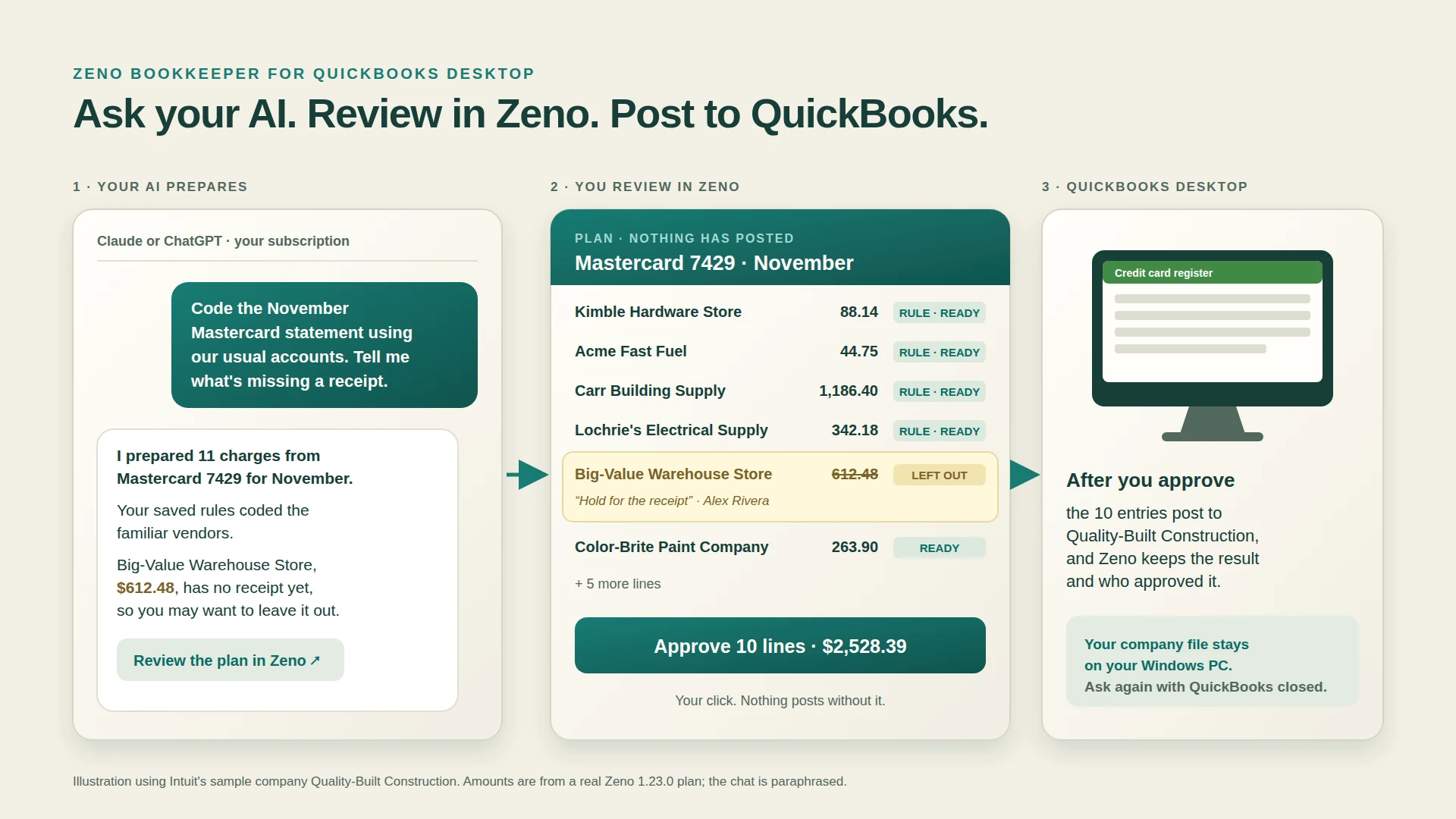
Ask your AI, review in Zeno, then post.
Your assistant prepares the work in your chat. You review the exact entries in Zeno on your PC, leave out anything that is not ready, and approve the rest. Only then do they post to QuickBooks Desktop.
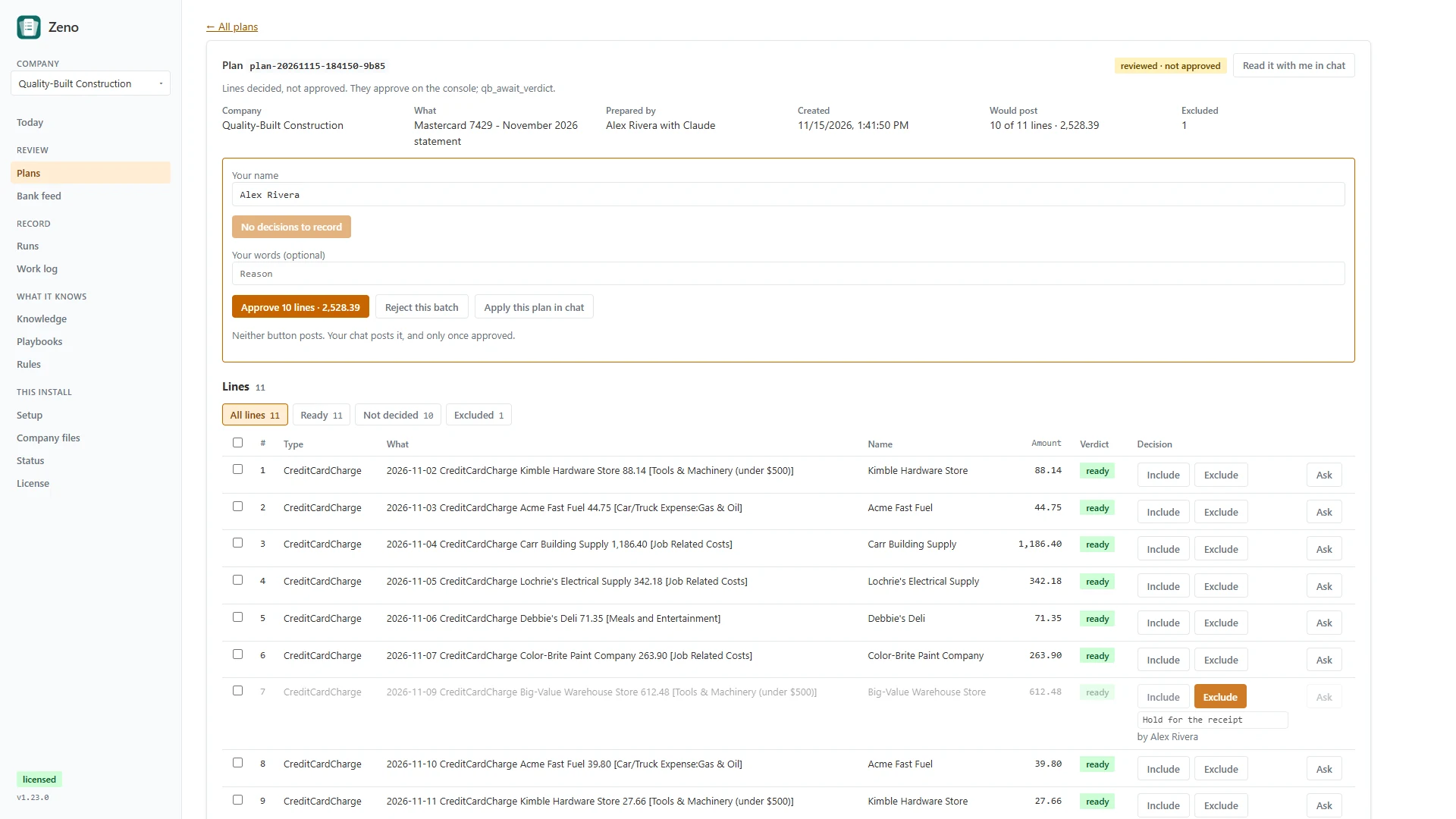
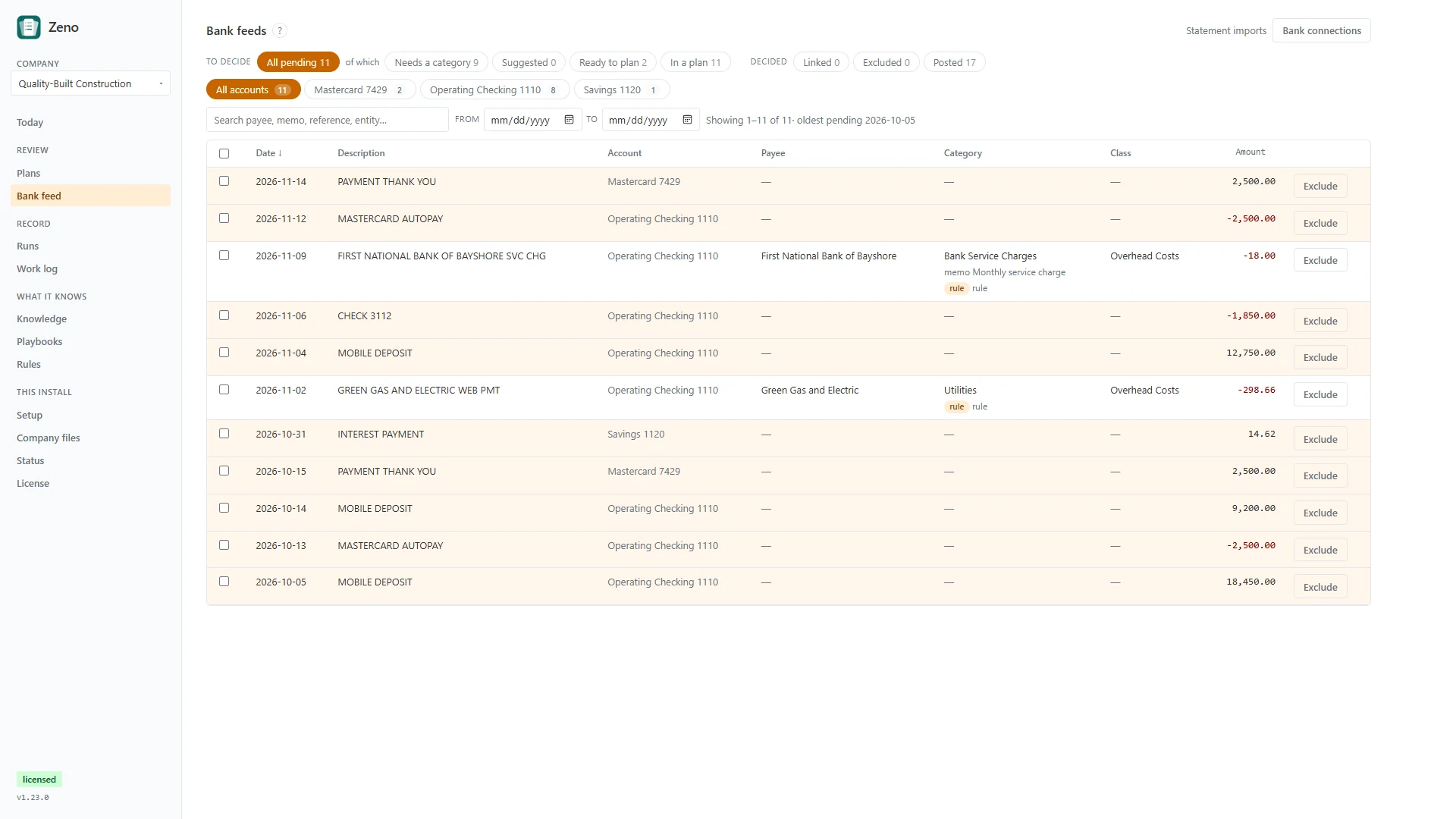
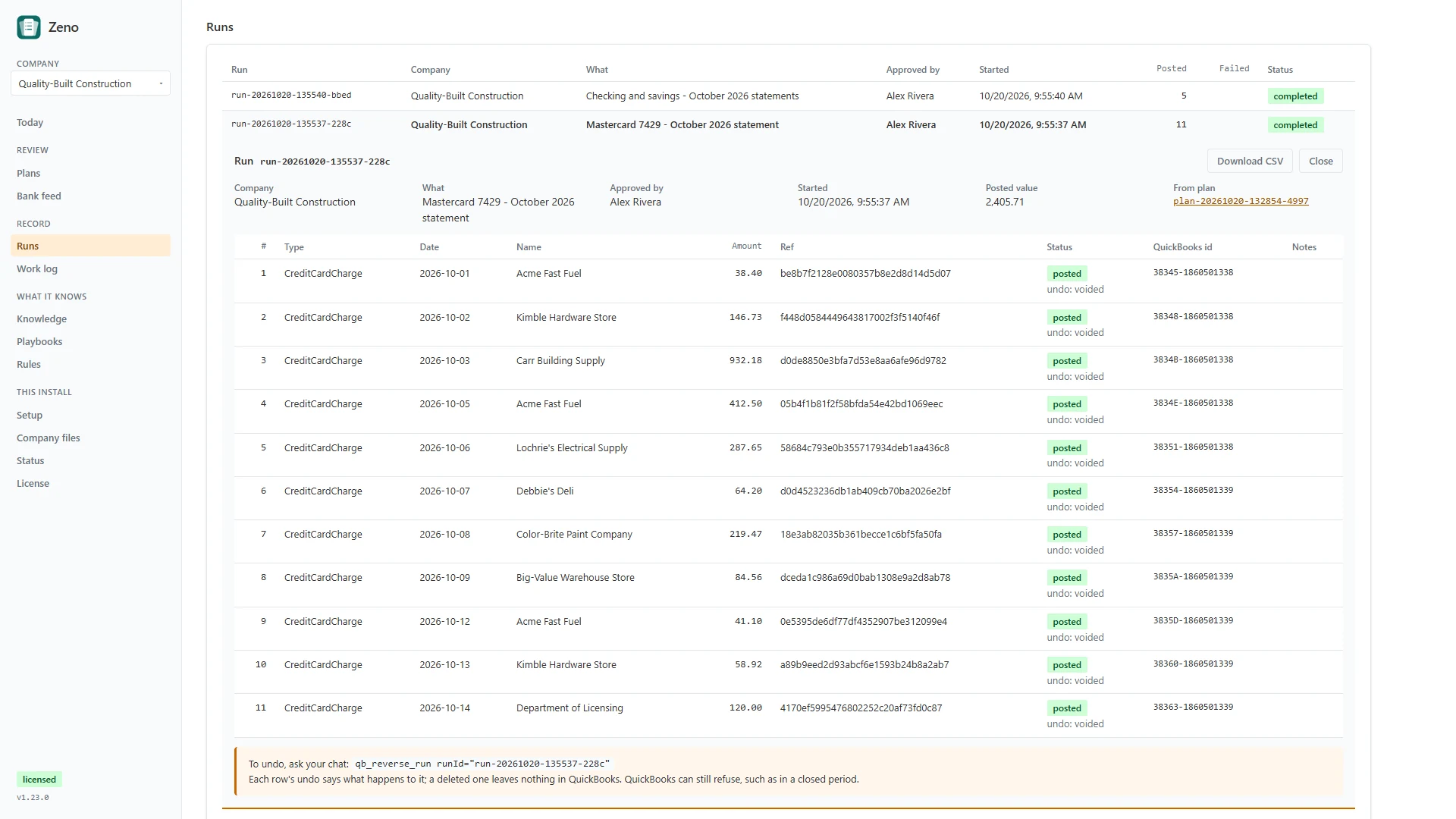
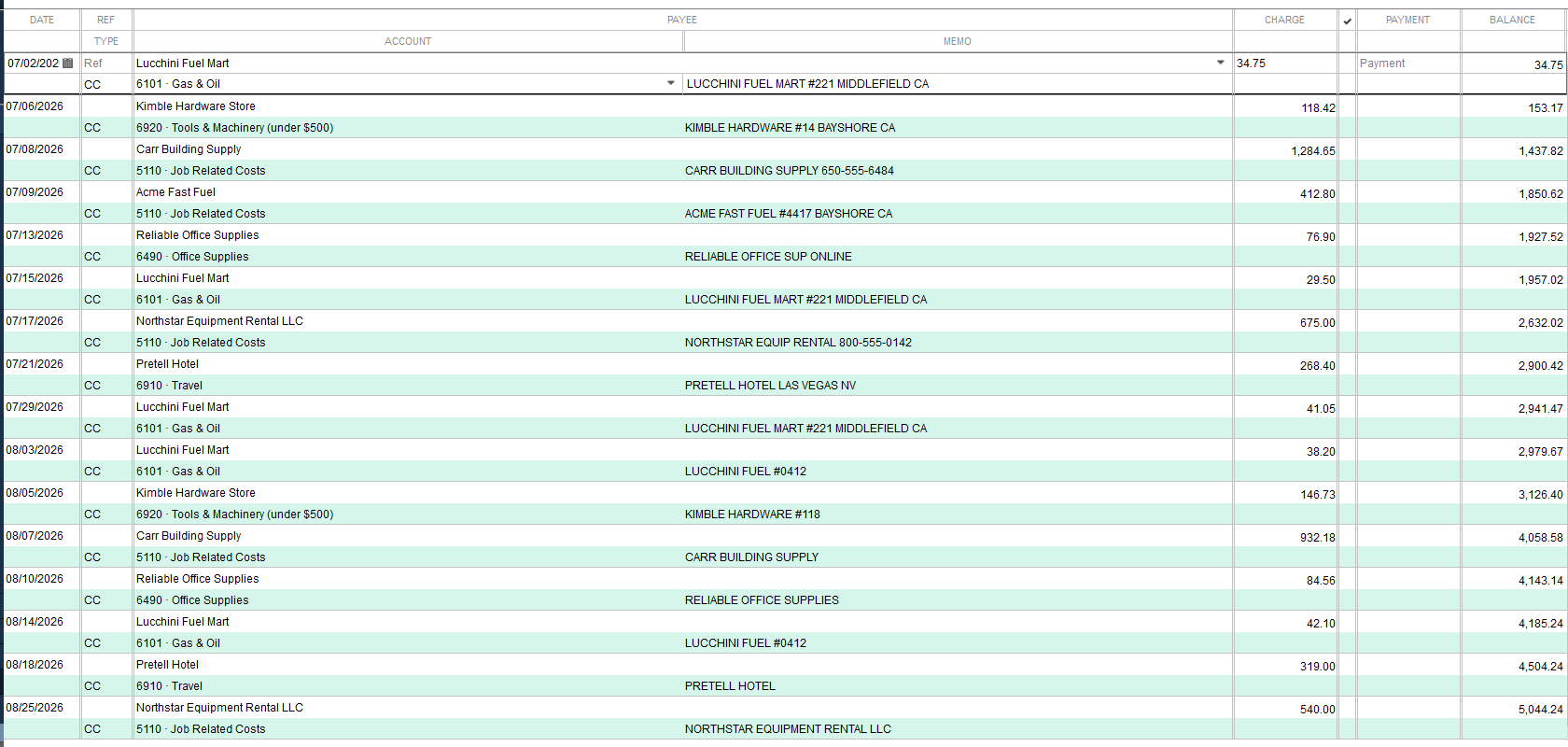
Review the plan. Ten charges ready to approve, one left out until its receipt arrives.Code with your rules. Lines from checking, savings and the card, filled in by the rules you confirmed.See what posted. Each entry with its QuickBooks ID, who approved it and how it can be undone.
Screenshots of Zeno on Windows, version 1.23.0, using Intuit’s sample company in November 2026. Sample company work, not customer results.
Start with the work on your desk
What would you like to get done today?
Describe the task in your own words. Your assistant uses the accounts, customers and vendors already in your books to prepare the work or answer your question.
BILLS AND RECEIPTS
Get the entries ready without typing each one.
“Prepare these supplier bills. Show me anything that might already be entered.”
Your AI prepares the entries for review. You check the coding and amounts, with possible duplicates and missing information called out.
BANK AND CARD TRANSACTIONS
Review a month of charges together.
“Code this card statement using our usual accounts. Leave the charges with missing receipts for me.”
Saved rules handle familiar vendors. You can approve the ready entries and leave the rest until you have what you need.
QUESTIONS ABOUT THE BUSINESS
Find out what is behind the number.
“Why did repairs cost more this month? Show me the bills.”
Ask follow-up questions and check the transactions behind the answer. Owners can understand the books without taking over the bookkeeping.
See it in QuickBooks Desktop
A card statement, ready for your review.
In this example using Intuit’s sample company, Claude prepared eight Mastercard charges. The reviewer approved seven and left out a restaurant charge while waiting for its receipt. The ready work could be finished without guessing about the missing receipt.
Claude prepared eight charges from the Mastercard statement. Saved rules supplied the coding for familiar vendors, and Zeno flagged a future date for the reviewer to check.
The reviewer left out the $96.40 Alan’s Diner charge while waiting for its receipt. The other seven charges, totaling $2,102.77, were approved for posting.
All seven approved charges appear in the QuickBooks register. The restaurant charge was left out. Zeno kept the results and the reason it was left out for the next person working on the books.
Keep the coding and client notes you have already worked out.
Save recurring instructions with the company they belong to. Your assistant can use them the next time you work on those books, even in a new conversation.
REPEAT VENDORS
Stop coding the same charges from scratch.
Confirm a rule such as “Lucchini Fuel goes to Gas & Oil.” Zeno uses it to code future matching transactions for review.
CLIENT INSTRUCTIONS
Keep the details that are easy to forget.
Save how a client splits an expense or the steps in their monthly close. Those instructions are available when your assistant prepares the next task.
WORK HISTORY
Pick up where the last person left off.
See what was requested, what was approved and what posted. The next bookkeeper can find the reason for a decision without searching an old chat.
You decide what goes into the books
Review the entries before they post.
See the proposed accounts, amounts and supporting documents in Zeno. Leave out anything you are unsure about and approve the entries you are ready to post.
Afterward, you can see what QuickBooks recorded and who approved it. Zeno also offers reversal for supported entries; what can be undone depends on the transaction and the current books.
01
Choose the company
Zeno checks that QuickBooks has the company file you selected open before preparing the work.
02
Check the proposed entries
Review the coding, amounts, possible duplicates and missing information together.
03
Approve what is ready
Your approval covers the entries you reviewed. Relevant changes in QuickBooks can require another review before posting.
04
See what posted and what still needs you
Check the result of each entry, including anything that could not be posted, and return to the unfinished work.
Beyond bills and bank statements
Get help with the rest of the bookkeeping, too.
Prepare customer invoices, record payments, work through the close or clean up old entries. Find the tasks that take up your week and see how Zeno can help.
Inventory and jobs: prepare inventory adjustments, assembly builds, time and mileage entries where your edition and licence support them.
Cleanup: review corrections to transactions, accounts, customers and vendors together.
Client work: compare results across registered company files and keep each client’s instructions and work history available.
Getting started
Use the company file you already have.
Install Zeno on the Windows PC where you use QuickBooks Desktop. The setup guide helps you choose your company file, approve access in QuickBooks and connect your assistant.
Your company file stays on your PC. The records your assistant requests are sent to Claude or ChatGPT under your account’s settings and policies.
QuickBooks Desktop Pro, Premier or Enterprise on a Windows PC.
Your own Claude or ChatGPT subscription, purchased separately.
A QuickBooks Administrator to approve Zeno’s access to each company file during setup.
Your first task: choose a familiar statement or a few bills, ask your assistant to prepare them, and review the proposed entries.
Try it on your own books
Start free. Buy once when you are ready.
Try the full product for 150 transaction postings with no credit card. A licence lets you continue posting and includes 12 months of updates. After that, updates are optional and your covered version keeps working. QuickBooks and your AI subscription are separate purchases.
Want transactions straight from the bank? AI Bank Feeds are an add-on: $2 per connected bank account per month, $19 minimum, no free trial, held on a Zeno account. The licences below need no account. How bank feeds work →
Core
Solo or in-house
$449
One time · one workstation
Two company files
Everyday bills, sales, banking and journal entries
Review and history are included in every licence, along with reports and reversal for supported entries.
Keep everything from your free evaluation. Your licence activates the same installation, with your company setup, saved rules, notes and work history in place.
Deciding what comes next for QuickBooks Desktop? Read about service changes and your options.