What to ask

Say it the way you would to a good junior.

You don’t need special wording. Name the client, the period and what you want, and say what to leave alone. Below are the requests bookkeepers send most, by the job, with what comes back. Anything that changes the books comes back as a plan you approve.

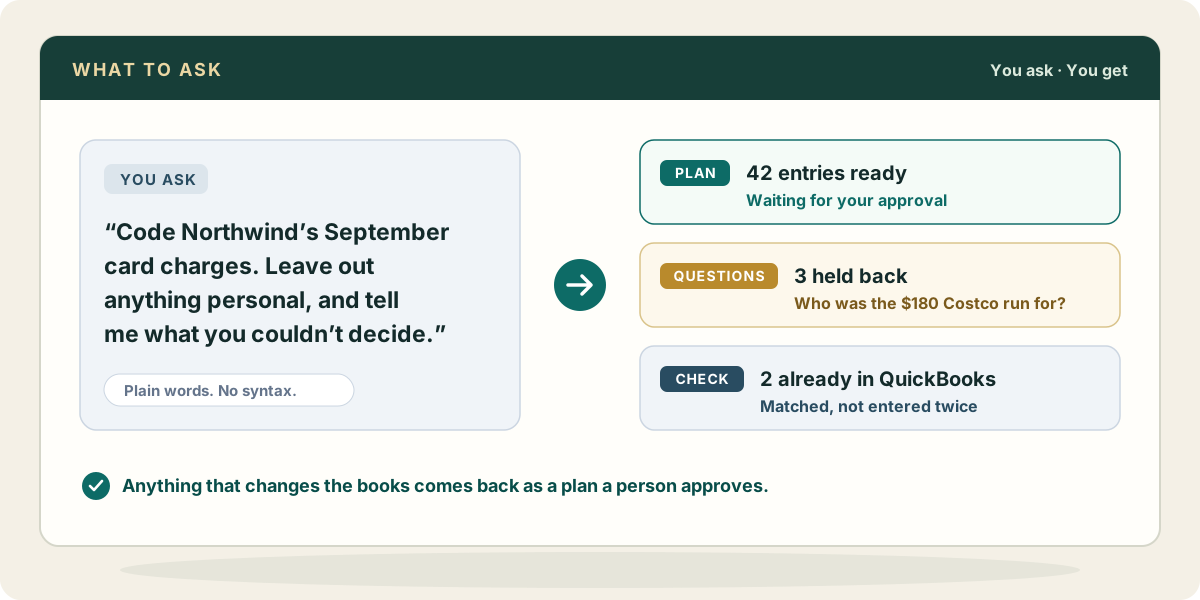
Illustration: a bookkeeper asks for September’s card charges to be coded, leaving out anything personal. What comes back is a plan of 42 entries waiting for approval, three questions held back, and two lines matched to entries already in QuickBooks.
Before you touch anything.

Taking on a client

You ask“We just connected Lakeside Dental. Run the check-up and tell me what I am walking into. Don’t change anything.”

You getNineteen built-in checks over the books: holding accounts that never washed to zero, invoices open past 90 days, payments never applied, lines parked in Ask My Accountant, names entered twice. Each finding comes with the transactions behind it. Nothing in QuickBooks changes.

You ask“Read the last two years and tell me how this client works.”

You getDrafts of how each vendor is usually coded, which ones bill on a rhythm, whether classes are really used, which accounts went quiet and when the month usually gets closed. They are drafts: you confirm the ones that are right, and only then do they guide the next month.

You ask“What is left to set up for Lakeside, and what do you need from me?”

You getThe steps still open, such as a bank account with no feed or a Stripe account the books mention that is not connected, and the questions only you can answer once the books are read, such as how the owner is paid. Your answers are saved with the client as drafts you confirm.

Bank lines, bills and receipts.

The monthly work

You ask“Code Northwind’s September card charges. Use our rules, leave out anything personal, and tell me what you couldn’t decide.”

You getA plan of ready entries, with lines that are already in QuickBooks matched instead of entered twice and transfers paired. The lines held back come with the question that would settle each one. You approve the plan; it posts as one run.

You ask“Enter the bills that came into the inbox this week.”

You getA plan of bills read from the documents, each with the vendor matched to the client’s vendor list and the document attached. A document that looks like one already received is flagged, and anything Zeno has already posted is marked before you approve.

You ask“Match the receipts to last month’s charges and tell me which charges over $75 still have none.”

You getA table of proposed pairs with the amount and date gap for each, then the receipts with no charge and the charges with no receipt.

You ask“Book Harbor Coffee’s Square payouts for October.”

You getEach payout split into sales, refunds, fees, sales tax and tips, matched to the deposit on the bank line, as a plan to review.

Books someone else kept.

Cleaning up

You ask“Move last quarter’s fuel charges out of Automobile into Vehicle Fuel. Show me what changes before anything does.”

You getOne plan covering every affected document, each line shown before and after, so you approve the correction as a whole and can undo it as a whole.

You ask“Which vendors look like the same company entered twice?”

You getPairs whose names differ by a space, a suffix or a capital letter, with how much history each carries. Retiring the duplicate is a plan you approve: future entries go to the name you keep, and the history already posted stays where it is.

You ask“Undo yesterday’s run for Northwind. We posted the wrong month.”

You getThe run reversed as a run of its own, with a note for anything that could not be fully put back, such as a deleted document that returns under a new number.

When the client asks what the numbers say.

Answering the owner

You ask“What did Lakeside spend on supplies this year compared with last, and which vendors moved it?”

You getThe figures from QuickBooks’ own profit and loss, read live, with the vendors behind the change. The same numbers the client would see if they ran the report.

You ask“Who owes Northwind money, and for how long?”

You getThe receivables aging, read live at that moment, never added up from an older copy.

You ask“How are we doing against the budget for Q3?”

You getThe client’s QuickBooks budget compared with the live profit and loss, line by line.

When the books cannot answer.

Asking the client

You ask“Draft a question to Harbor Coffee about the $2,400 deposit on the 14th with no invoice behind it.”

You getA plain question waiting on the Questions page. Nothing is mailed until someone at the firm sends it. The client answers by link or by replying to the email, and the answer comes back to the client’s file.

You ask“What has Harbor Coffee answered since last week?”

You getTheir replies, each beside the question and the transaction it was about.

You ask“Did Harbor Coffee’s owner settle the questions on last week’s bank lines?”

You getTwo lines answered with receipts their AI retrieved from the owner’s Google Drive, and one with a signed agreement. Ready in a plan to review and post to QuickBooks Online with the documents attached.

Monday morning.

Across the practice

You ask“What recurring work is due across all our clients this week?”

You getEach client’s due periods with the written procedure that goes with it, so the work starts from what the firm already decided.

You ask“What did we do on Lakeside last month, and what is still open?”

You getThe work log: what was done, why, and what was left for next time, written as the work happened.

You ask“We always code Comcast to Telephone & Internet. Remember that for Northwind.”

You getA draft rule, with the past transactions it would have matched so you can see what it catches. It applies once a person confirms it.

Three habits that make the answers better

Say what not to touch.

“Don’t change anything” turns a request into a read. “Leave out the owner’s personal charges” saves a round of trimming. Zeno will not post without an approval either way, but a clear limit gets you a cleaner plan the first time.

Correct it once, in words.

When a line comes back coded wrong, say why: “Costco is office supplies for this client, not groceries.” Ask Zeno to remember it, and the correction becomes a draft rule you confirm, so next month starts from it.

Ask for the questions, not just the answers.

“Tell me what you couldn’t decide” is the most useful sentence on this page. A list of five honest questions is worth more than five confident guesses.

Doing the same thing every month? Turn it into a skill or slash command → · Not sure where the limits are? What Zeno will not do →

14 DAYS FREE · NO CREDIT CARD

Connect one client and try three of these.